How to Stop Your Mecha Suit Looking Like Iron Man (Chest-Plate Fix)
 AI Mecha Transformation Team
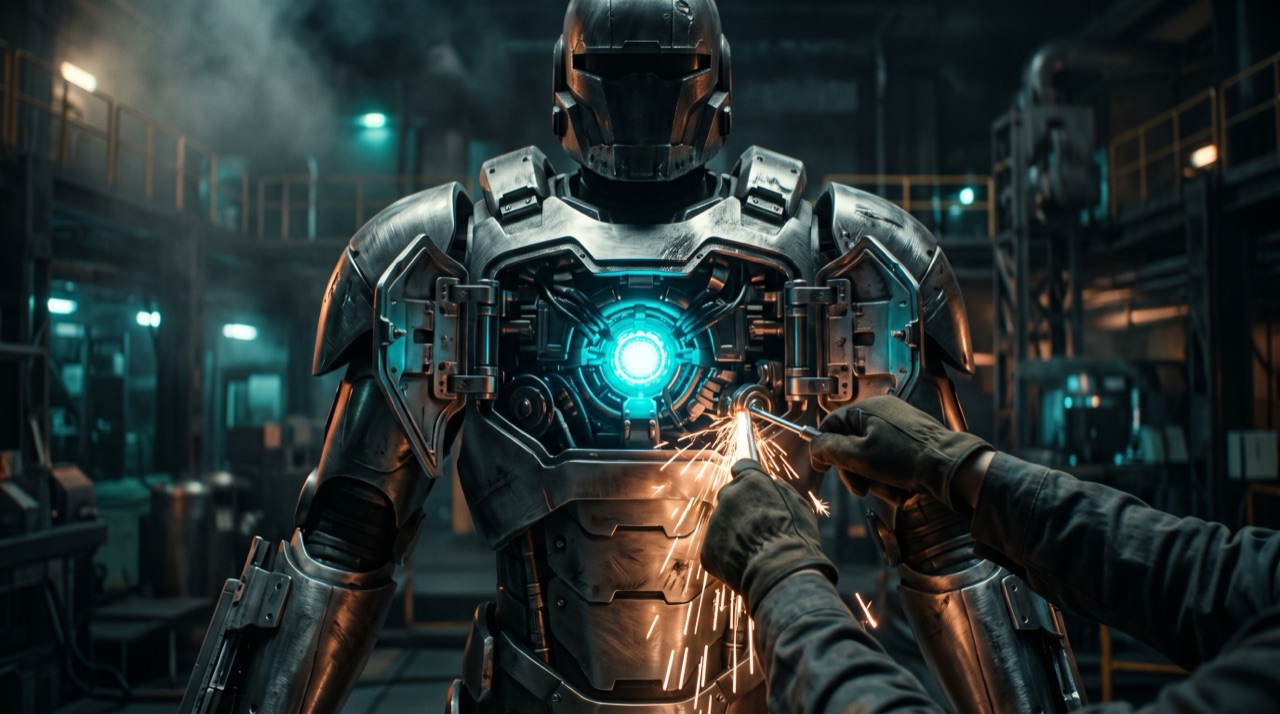
The glowing chest circle is the most common mecha transformation failure. Here is why the model reaches for that shape, and the four-clause chest-plate fix that makes the armour read as its own design.
How to Stop Your Mecha Suit Looking Like Iron Man (Chest-Plate Fix)
You asked for a mecha suit and the render handed you a red-and-gold chest with a circle of blue light in the middle. The face is right, the timing is right, the armour is completely generic. It is the single most common complaint in this format and it is not the model being lazy — it is the model doing exactly what a language-conditioned video model does. Ask for "armour" with no further instruction and you get the most average, most legible, most photographed armour shape in its training data.
The fix is not to write the word mecha harder. It is to describe a chest plate instead of a hero.
Why the model goes there
Three mechanisms push every unconstrained render toward the same silhouette:
- Prototype pull. When a prompt names a category ("mecha armour", "superhero armour", "robot suit"), the model resolves it to the category's most represented example. Armour with a glowing circular emitter is that example.
- Leaving the chest undescribed. A prompt that orders the plating on the forearm and the shoulder but says only "the chest plate rises" leaves one hole, and the model fills holes with the prototype.
- Naming the shape you are trying to avoid. Writing "not Iron Man" is worse than saying nothing. Negation in a prompt is weak, and the name itself is a strong token that drags the render toward the thing you named. Negative instructions belong in the checklist, not in the prompt.
There is a fourth, subtler cause worth knowing: an unlit, undescribed chest is visually empty, so the model adds a light to give the frame a focal point. Give it a different focal point — a seam that catches a highlight, a bolted plate, a hinge — and it stops needing a lamp.
The four-clause chest fix
Append this to any preset prompt. Each clause closes a different door.
| Clause | Purpose | Copy-paste text | | ---------- | ----------------------------------------- | ----------------------------------------------------------------------------------------------------- | | 1. Shape | Replaces "armour" with a described object | "The chest is a single bolted rectangular plate, four visible hex bolts at the corners" | | 2. Surface | Kills the polished-hero look | "Brushed gunmetal steel with a hairline scratch and a matte finish, no polish, no mirror shine" | | 3. Light | Removes the glowing emitter | "The plate is entirely unlit: no glowing circle, no light in the centre of the chest, no arc reactor" | | 4. Palette | Blocks the default colourway | "Charcoal and oxidised copper with a worn canvas strap, no red, no gold" |
Applied to the carrot preset, the chest sentence becomes something like: the chest plate is a single bolted rectangular panel of brushed gunmetal with four visible hex bolts, unlit, no glowing circle, and the whole suit stays charcoal and oxidised copper — no red, no gold.
That is a longer prompt, and it is still one action, one continuous shot, one subject. Detail is not the same as complexity.
Before and after, in observable terms
| What you see | What the prompt lacked | Clause that fixes it | | ----------------------------------------------- | ----------------------------------------------- | ------------------------------ | | Circle of light in the middle of the chest | Any chest description at all | Clause 3 | | Red and gold colouring | Palette constraint | Clause 4 | | Mirror-polished plating that looks plastic | Surface description | Clause 2 | | Chest that grows and shrinks between frames | A fixed shape to hold | Clause 1 | | Plates that float without attaching | Attachment language: "seams", "hinges", "locks" | Clauses 1 and 2 combined | | A smooth unbroken breastplate with no mechanism | Assembly order | Name the order, not the beauty |
Here is the preset library again — each of those prompts is the exact text the studio sends, so you can read what a constrained chest looks like when it lands.
このクリップ:30クレジット · 月6本で$39.90(Pro)、または年80本で$319
Where to put the fix in the prompt
Order matters more than people expect. The model weights the early part of a prompt more heavily for subject definition, and the style tail more heavily for mood. Put the chest fix in the middle, where the armour is being described:
- Subject lock — face, hair, skin tone, build exactly as photographed.
- Trigger and one action — the object and the touch.
- Assembly order with the chest fix inserted — forearm, chest, shoulders, visor, with the bolted unlit chest named at the moment the plate rises.
- Style and delivery — camera, lighting, format, exclusions such as no text and no watermark.
Putting "no red, no gold" in the style tail is fine. Putting "no glowing circle" in the style tail is weaker than putting the unlit, bolted description at the moment the chest plate is described.
The same failure, four other places
The prototype pull is not a chest problem. It shows up wherever you leave a shape unspecified:
- Helmet. Unspecified helmets trend toward the same smooth full-face dome. Fix: "open-face helmet with a visible jaw guard and two narrow eye slits".
- Shoulders. Unspecified pauldrons grow into large rounded capsules. Fix: "layered rectangular shoulders that fold flat, like stacked toolboxes".
- Hands. Unspecified gauntlets turn into claws. Fix: "articulated fingers in thick plates, the knuckles still visible".
- Boots. Unspecified boots turn into rocket thrusters. Fix: "heavy industrial boots with magnetic soles, no thrusters, no flames".
Same pattern each time: name the object, name the surface, kill the glow, constrain the palette.
Checking the clip before you publish
- Pause at the frame where the chest plate seats. Is it one plate with a describable shape, or a vague glow?
- Look at the seams. Are the plates attached to each other, or hovering?
- Check the colour count. Two or three dominant materials reads as designed; six reads as a toy.
- Watch the chest for size drift. A plate that grows between frames means the prompt described a feeling, not a shape.
- Confirm the face. If the identity clause held through the chest fix, keep this prompt as your template.
If the chest is right but the render failed for other reasons, work through the failure list. If you are still writing your first prompt, the prompt library has four complete versions to start from.
Cost of iterating
Tuning a chest plate takes two or three renders, which is affordable if you test at the cheap tier: 5 credits for 480p, 10 for the standard 720p clip, 30 for the 1080p default. Failed renders return their credits, and a test render that proves the chest reads is money well spent compared to a beautiful 1080p render of the wrong armour. See pricing for what a top-up costs.
FAQ
Should I write "Iron Man" in the prompt? No. That puts the name in the conditioning and pulls the render toward exactly that design, and it places a famous character in your clip — which is also a rights question, not just a taste one. Describe the plate instead.
Is this site connected to any film or character franchise? No. It is an independent tool with no affiliation to any film, game or franchise, and it ships no branded presets.
Why does the armour get better when I add boring words like "bolted"? Because "bolted" is a shape the model can draw, and "epic" is not. Concrete nouns beat adjectives in image-conditioned generation.
Will a longer prompt slow the render down or cost more? No. Credits are charged by resolution and length, not by word count. A 120-word prompt and a 40-word prompt at 1080p and 12 seconds both cost 30 credits.
Can I keep the glowing core on purpose? Yes — if that is your design, describe it as yours: a specific housing, a specific colour, a specific place. Just know that an undescribed glow is what reads as borrowed.
What if the chest fix breaks the face? It usually means the prompt now spends so many words on armour that the identity clause got buried. Keep the subject lock as the first sentence, always.
The presets on the front page already ship with a constrained chest plate, which is a better starting point than a blank prompt box.